Gökyüzü Panel

LED Remotes & Controllers

35 products

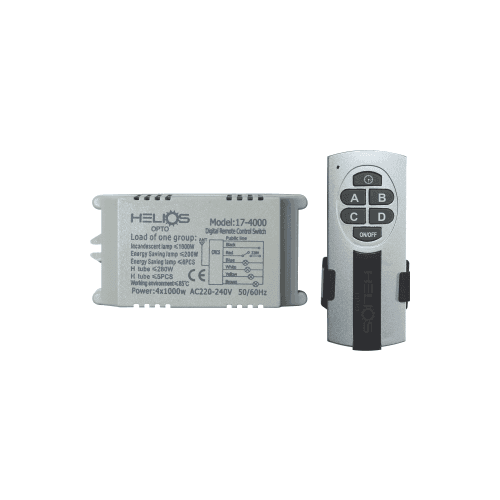
An LED controller is the unit that governs the colour, brightness and effects of strip and RGB systems. On a single-colour strip its job is to set brightness; on RGB and RGBW strip it also manages the colour mix. The control method shapes everyday use: an RF remote works through a wall, while an infrared (IR) remote needs line of sight. Wi-Fi and Bluetooth units add phone control and let you save scenes. The controller must match the strip's voltage (12V, 24V) and channel count (single colour, RGB, RGBW); a mismatched controller either does not work at all or drives the colours incorrectly.

Related Categories

Choosing an LED Remote or Controller: A Compatibility Guide

A controller is never chosen on its own — the strip, the driver and the controller must all three be compatible. In a mismatched pairing the light flickers, the colours come out wrong, or dimming cuts out completely at low levels. Our collection holds 35 products.

1. Identify the Strip Type

  • Single colour: only on/off and dimming are needed; the simplest controller is enough.
  • CCT (adjustable colour temperature): shifts between warm and cool white; needs two channels.
  • RGB: three channels — red, green, blue.
  • RGBW / RGBWW: a separate white channel in addition to the colours. White light comes from a real white chip instead of being mixed from colours; in daily use the difference is clear.

The number of channels on the controller must be exactly the same as on the strip.

2. Method of Control

  • Infrared (IR): economical but needs line of sight; if you hide the receiver it will not work.
  • Radio frequency (RF): works through a wall and from the next room; the most practical option for most installations.
  • Wi-Fi / app: gives phone control and scheduling; network details are needed during setup.

3. The Controller's Power Limit

The load passing through the controller must not exceed its capacity. Common classes in our catalogue are 50 W, 100 W, 150 W, 200 W and 300 W. If the load is larger, split the run or use a power repeater; pushing the limit makes the controller heat up and fail. You can choose a suitable power supply under LED modules, drivers and transformers.

Budget

Our 6 products with a published price run from 3.03 EUR to 86 EUR, with a median of 5.97 EUR. For the remaining products the page shows a quote option.

Order of Installation

The order of connection matters: mains → power supply → controller → strip. Putting the controller before the power supply feeds mains voltage into it and destroys the device. Enclosing the receiver in a metal box weakens the radio signal; an infrared receiver must always be left in the line of sight. On long runs, placing the controller at the middle of the line sends an equal signal to both ends.

Frequently Asked Questions

Can I add a controller to my existing strip?

You can, provided the channel count and the voltage match; check the label of your LED strip.

Does it work together with a wall switch?

Most controllers remember the last setting when the supply is cut; this behaviour is stated in the product description.

Can I run two rooms from one remote?

Multi-zone models support this; single-zone models do not.

Related Guides