Emergency Exit Lights: What They Do and How to Choose Them
An emergency exit light runs on its own battery when the power fails and keeps the evacuation route visible. In smoke and in panic, it is often the only sign showing the way out. Our collection holds 2 products.
Two Different Jobs, Two Different Products
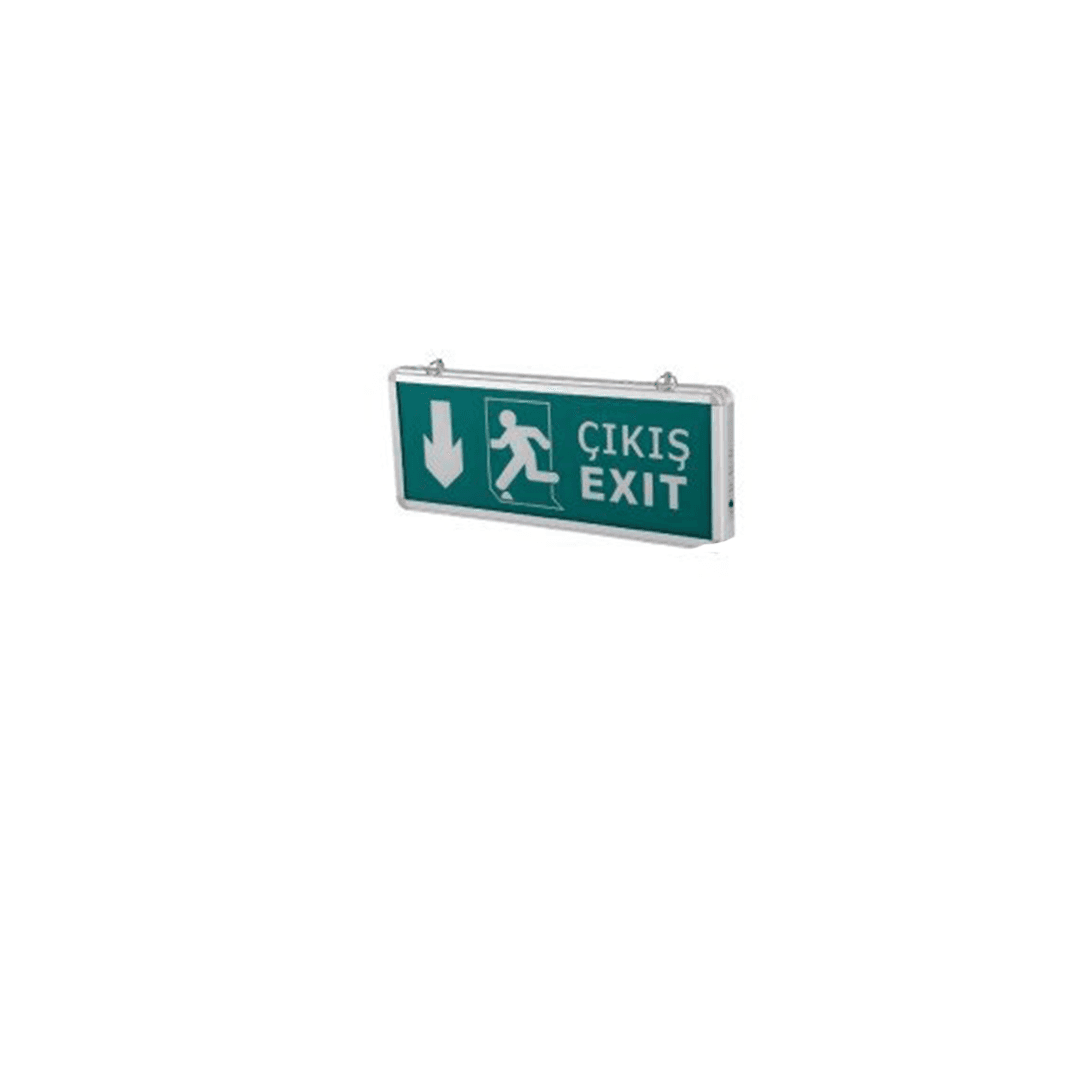
- Exit sign luminaire: carries a pictogram showing the direction of the exit. It points to the escape route and the door.
- Emergency lighting luminaire: carries no pictogram; it lights the space during a power cut so that people can move safely.
In most premises both are needed: the direction must be shown and the route itself must be visible.
Maintained or Non-Maintained?
Maintained models are lit under normal conditions as well and switch to the battery during a cut; non-maintained models come on only when the power goes. Because a pictogram exit sign is expected to be visible at all times, the maintained type is the common one.
Regulations: Know What Is Required
Emergency lighting and exit signage are governed by fire safety regulations; the position of the luminaires, their spacing, the battery duration and the form of the signs are defined in those rules, and they differ from country to country. We do not declare that any product complies with regulations — on a project basis that assessment is a matter for a qualified engineer and the fire authority's inspection. Before installation, have the requirements of your project confirmed by a competent person.
Maintenance
The battery of an emergency luminaire loses capacity over time, and that is not noticed until there is a power cut. Regular testing — on most products with a test button — is the only way of showing whether the luminaire actually works. An emergency luminaire that is not tested is no different from one that is not there.
Budget
Of the 2 products in our catalogue, one has a published price: 11 EUR. On the other, the quote option appears on the page.
Where, and How Often?
The purpose of emergency lighting is that the escape route stays visible without interruption in the dark. That is why the luminaires are placed not only at the exit door but at every point where direction changes: corridor turns, stair landings, floor exits and doorways. If a dark gap is left between two luminaires the run loses its function — visibility is already limited under smoke. The pictogram of an exit sign must be positioned so that it shows the escape direction without hesitation.