An emergency exit light is a product that does nothing on most days after it is bought — and that is exactly why it is the easiest one to neglect. In a corridor left dark by a power cut, it is the only thing that lets people find the way out. This guide explains how the fitting works, which technical figures actually mean something, where it has to go and how to be sure it is still working. Installation and inspection requirements are governed by the fire regulations in force where the building stands; what is set out here is what such regulations ask for, and no compliance is claimed for any product.
How it works: charging, outage, automatic changeover
Inside the fitting there is a battery, a charging circuit and a monitoring circuit. While the mains is present the fitting runs from the mains and keeps the battery continuously charged. When the mains fails, the monitoring circuit detects it and the supply switches automatically to the battery — a changeover too short for the human eye to catch.
This behaviour has an important consequence: the fitting's protective device must be on the same circuit as the lighting it watches. If the lighting circuit trips while the fitting goes on being fed from another circuit, the space goes dark but the fitting counts it as "no outage" and never switches to battery.
The charging time is printed on the product label and is typically of the order of twenty-four hours. A test carried out on a newly installed fitting before its first charge completes does not show the battery's true duration.
- The fitting must be fed from the SUPPLY of the lighting circuit it monitors.
- The changeover is automatic; no manual action is needed.
- The first test is carried out after a full charge is complete.
The difference between maintained and non-maintained
A non-maintained fitting lights only during an outage; with the mains present it is dark, and a small indicator lamp on it reports the charging state. It is the common choice for stores, plant rooms and spaces used by day, and its energy consumption is low.
A maintained fitting is lit both with the mains present and during an outage. In cinemas, meeting halls and hotel corridors — places where the light is deliberately dimmed or where wayfinding is needed at any moment — the exit sign must stay visible at all times.
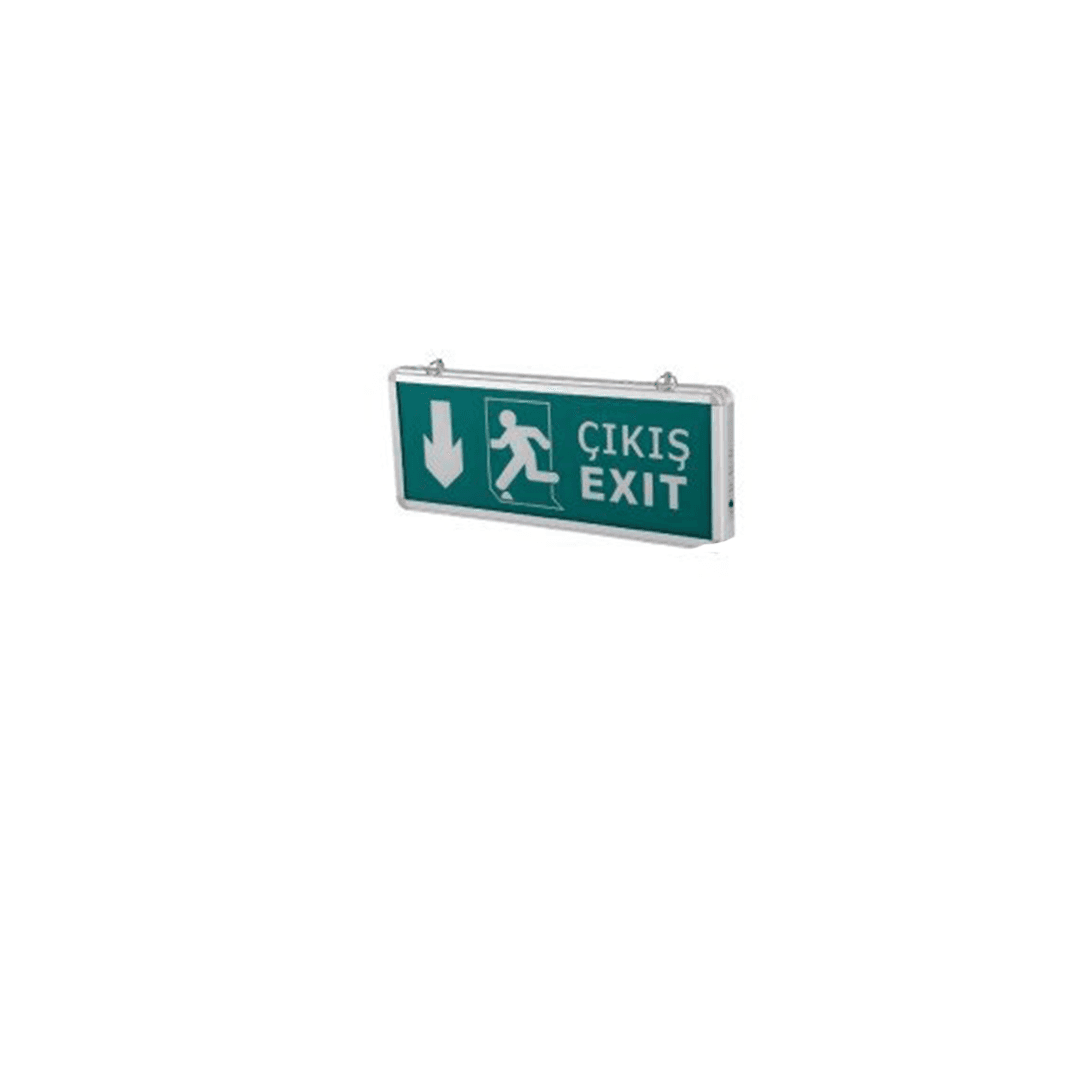
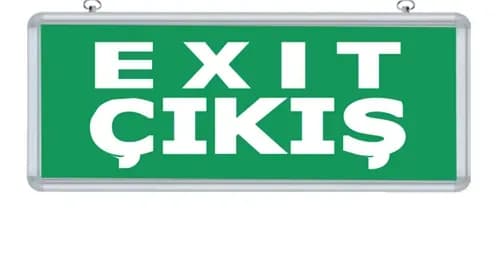
Exit fittings, that is directional signs, are mostly run maintained: the arrow and human figure on them read out the escape route even without an outage. Emergency fittings meant only to light a space can be non-maintained.
- Non-maintained: lights during an outage — stores, plant areas, spaces used by day.
- Maintained: lit at all times — halls, corridors, areas where the light is dimmed.
- Directional exit signs are generally installed to run maintained.
Battery duration and light output
The battery duration on the label says how many minutes the fitting will give light after an outage. That duration follows from the building's evacuation scenario: a small workplace and a multi-storey building do not need the same.
The second figure that sets the duration is the light output. The same battery feeds a brighter fitting for a shorter time. "A more powerful fitting is better" is therefore not a sound criterion; the sound criterion is delivering the required light level for the required time.
Battery capacity falls over time. The duration on a new fitting's label may not be obtainable from that same fitting three years later. The decline is silent: the fitting lights during an outage, but for less time than it should. Periodic testing is the only method that makes it visible.
- The duration follows from the building's evacuation scenario.
- A brighter fitting runs for less time on the same battery.
- Battery capacity falls over the years, and the fall does not announce itself.
Positioning and pictogram visibility
The basic principle is simple: at least one directional sign must be visible from every point on the escape route. Signs go above doors, at corridor corners where the direction changes, on stair landings and at floor exits. Someone who turns a corner and sees no sign loses their bearings.
The viewing distance of a pictogram relates directly to the height of the sign: the larger the sign, the further away it can be read. The viewing distance given in product descriptions states from what distance the sign can be made out, and sets the number of signs needed for the length of a corridor.
Stairs and changes of level are lit separately. The commonest accidents during an evacuation come from steps that cannot be seen in the dark. Intervention points such as a fire hose cabinet, a call point and a first-aid station are also expected to be visible during an outage.
The mounting height takes smoke behaviour into account too: smoke fills downwards from the ceiling, and a sign very close to the ceiling disappears early. Directional signs are therefore generally positioned at door-head level.
- A sign must be visible from every point on the escape route.
- The number of signs is calculated from the product's viewing distance.
- Stairs, changes of level and intervention points are lit separately.
- A sign tight against the ceiling is lost early in smoke.
Periodic testing: how do you know it works?
Whether an emergency lighting system works can only be known by trying it. The short function test is done by cutting the fitting's supply: the fitting must light and the indicator must behave correctly. This test is relatively frequent, short and easy.
The duration test measures whether the fitting stays lit for the time on its label, and it fully discharges the battery. After the test the battery has to reach full charge again; enough charging time must be left between two consecutive duration tests.
Tests are recorded. A test with no record counts as not carried out for inspection purposes and, more importantly, nobody notices the drop in battery capacity. A simple logbook with the date, the type of test and the result is enough for this.
Fittings with self-test run this cycle themselves and report the result through the colour of an indicator. In buildings with many fittings the manual testing load grows fast, so this feature saves time — but it does not remove the need to check the indicators regularly BY EYE.
- Short function test: the supply is cut and the fitting must light.
- Duration test: the fitting is measured against the time on the label.
- Every test is recorded with its date and result.
- Self-test indicators are also checked regularly by eye.
Maintained and non-maintained compared
| Property | Non-maintained | Maintained |
|---|---|---|
| With mains present | Dark — only the indicator is lit | Lit |
| During an outage | Lights from the battery | Goes on lighting from the battery |
| Typical use | Store, plant room, space used by day | Hall, corridor, area where light is dimmed |
| Energy consumption | Low | There is continuous consumption |
| Directional sign | Read during an outage | Read at all times |
Related guides: Cove Lighting: What is it and How is it Done?, IP Ratings for LED Fixtures: Bathroom, Kitchen and Outdoors, LED Strip Selection Guide: How to Choose the Right LED Strip?, Choosing an LED Driver and Dimmer: A Practical Guide. For product options for your project, see our Emergency Exit Lights page.