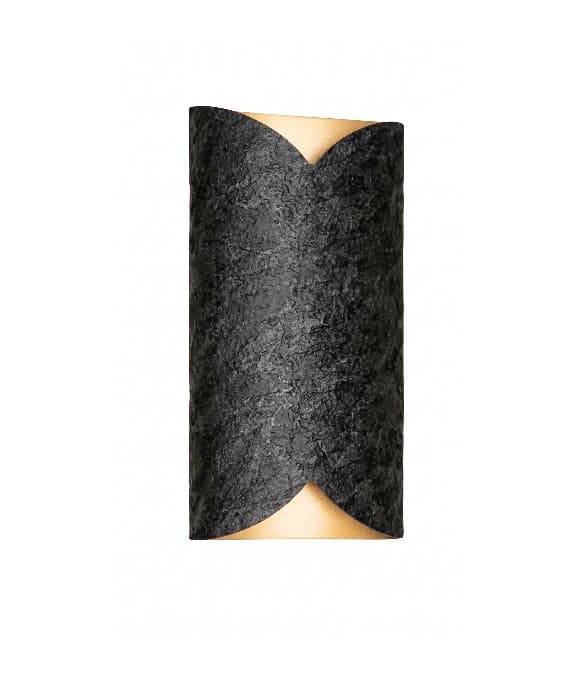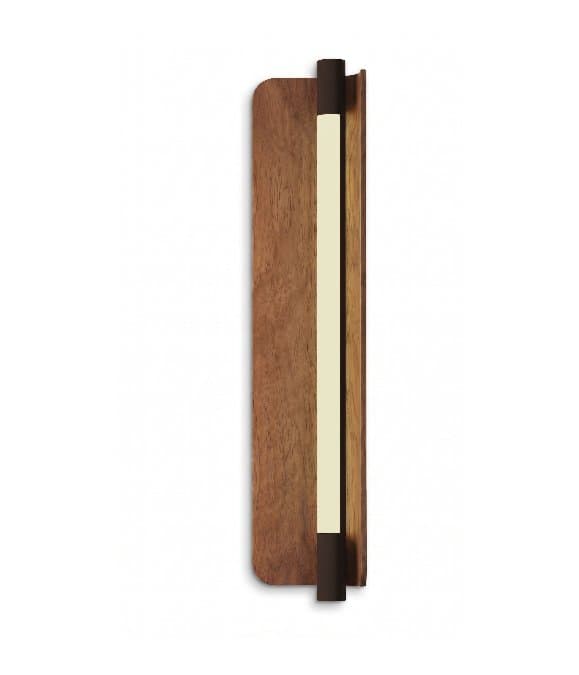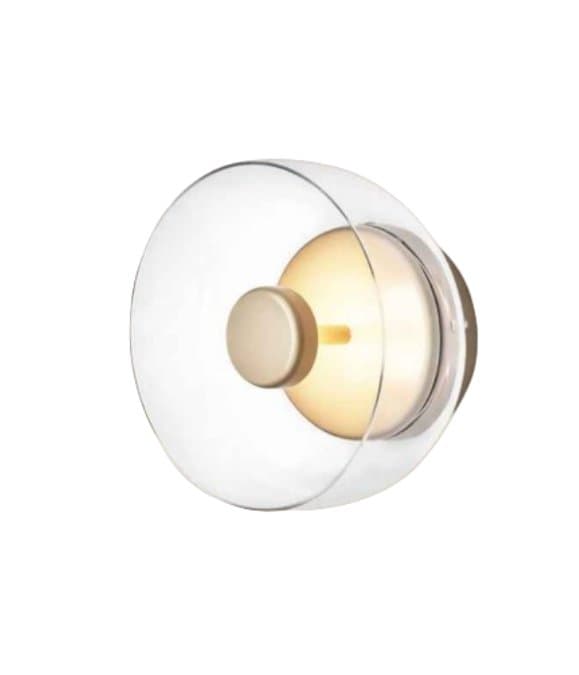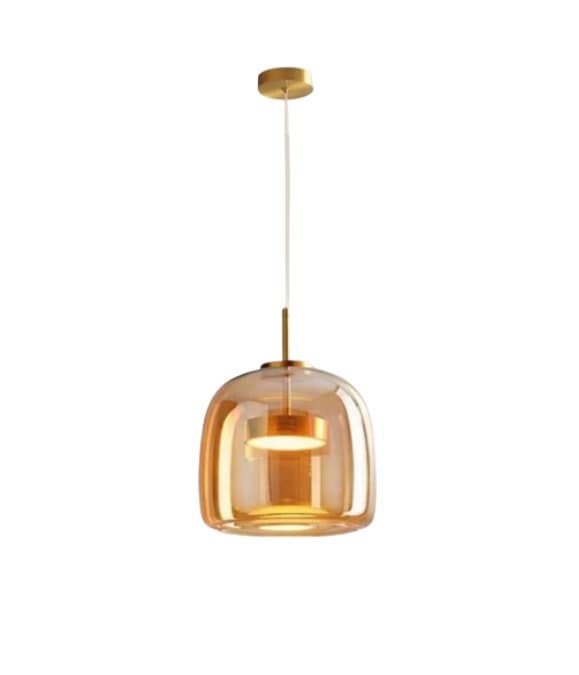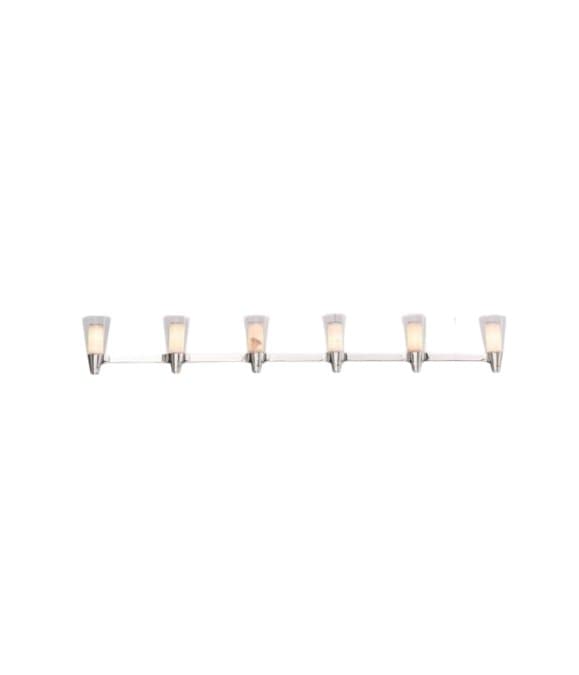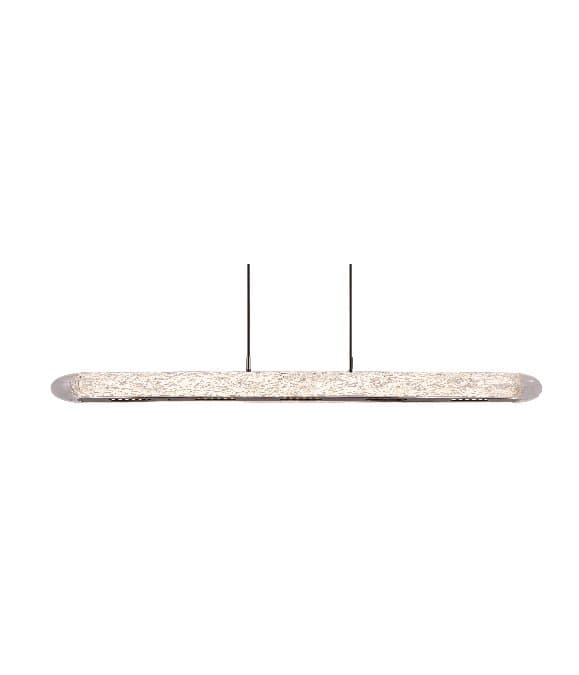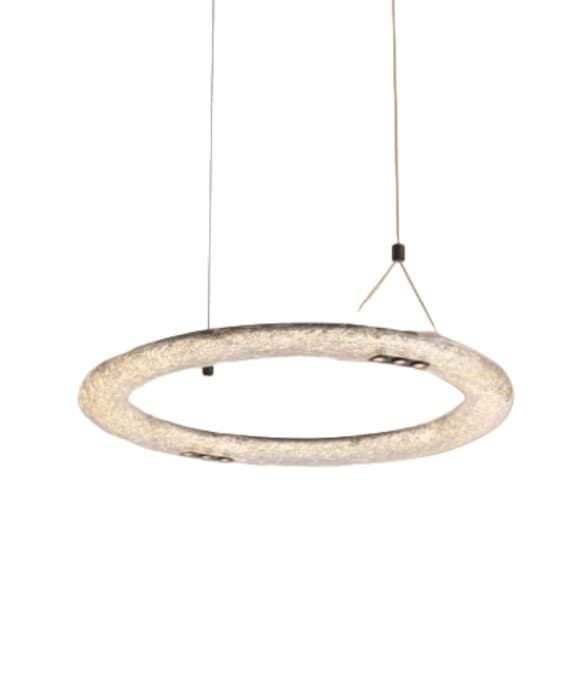

Wall sconces and pendants do the same job from two different places: instead of spreading light across the whole ceiling, they deliver it from a specific point. That shared property ties both choices to the same question. When you buy a sconce or a pendant, the real decision is not the shape of the model but the height at which it will sit and the size it will be. The right fitting hung at the wrong height glares, casts shadows or blocks the way. This guide works through the sizing decisions for both, and shows which reference each measurement is taken from.
What they share: light from a point, not from the ceiling
A room lit by a single ceiling fitting looks flat and lifeless: every surface has a similar brightness and the space gains no depth. Sconces and pendants break that flatness. A sconce lights the wall and gives the surface depth; a pendant defines the table or worktop beneath it and separates that area from the rest of the room.
They share something else: they work close to eye level. A recessed ceiling fitting stays outside the field of view when you are standing normally, while a sconce sits at a height close to eye level and a pendant sits directly in the line of sight. That is why these two types carry the highest risk of glare.
That risk sets the first criterion of the choice: the light source must not be directly visible when standing or sitting normally. In decorative models with an exposed holder this is solved through the choice of bulb; in models with a closed body it is solved through the height of the fitting.
- A sconce gives the wall depth; a pendant defines the surface beneath it.
- Both work close to eye level, so both carry a risk of glare.
- The first criterion is that the light source is not directly visible.
- These fittings come in addition to general lighting, not instead of it.
Mounting height for sconces
On living room, hall and corridor walls, the common starting assumption for sconces is that the centre of the fitting sits roughly 1.6 to 1.8 metres above the floor. That range is close to the eye level of a standing person; since the real aim is to keep the light source out of the eye, the final measurement is adjusted within that range according to the height of the people living there and the body type of the fitting.
Bedside sconces are measured from a different reference: not the floor, but the top surface of the bed. A sconce used for reading has to put light on the book without reaching the eye of the person sitting up in bed; roughly 50 to 70 centimetres above the bed surface is a common starting assumption. Being able to reach the switch from the bed is part of the same decision.
If more than one sconce is used in a corridor rather than a single one, the spacing between them becomes decisive. Sconces leave pools of light on the wall; open the spacing too far and dark bands appear between the pools, making the corridor look uneven. The spacing is kept close enough for the edges of the pools to meet.
On a staircase the reference is the step, not the floor. Each sconce must sit the same distance above the surface of the step it aligns with; a fixed height measured from the floor makes the sconces look irregular, because the steps rise along the slope.
- The common assumption is roughly 1.6–1.8 m from the floor; the exact figure is adjusted to the user.
- At a bedside the reference is the top of the bed, not the floor.
- In a corridor, no dark band is left between sconces.
- On a staircase each sconce is measured from its own step.
Light direction and wall surface
Sconces can throw light upwards, downwards or in both directions at once. Upward light washes the ceiling and softly enlarges the room; downward light leaves a beam on the wall and produces a guiding effect in circulation areas. Two-way models do both and give more light on their own.
The wall surface directly affects the result. Rough plaster, stone cladding and textured wallpaper produce hard shadows under directional light coming from close by; sometimes that is the desired effect, sometimes it exposes flaws. On a flat, matt wall the light forms a cleaner gradient.
What matters for glare is how far back the light source sits inside the body. Models with an opal diffuser or a deep body are more comfortable at heights close to eye level. In decorative models where the light source is exposed, the choice of bulb is the main factor that determines glare.
- Upward light enlarges the space; downward light guides.
- A rough wall produces hard shadows under light coming from close range.
- An opal diffuser and a deep body reduce glare.
- In models with an exposed holder, the bulb determines glare.
Drop length for pendants
The most frequently asked question about pendants is the drop length, and the answer is measured not from the ceiling but from the surface beneath. Over a dining table or worktop, the common starting assumption is that the lowest point of the pendant stays roughly 70 to 80 centimetres above the surface. That range brings the light close to the table without stopping people seated opposite each other from seeing one another.
In circulation areas the measurement is taken from the floor. In halls, corridors, stairwells and doorways — anywhere people walk underneath — the lowest point of the pendant must stay comfortably above head height; the common assumption is roughly 2.1 metres from the floor and above. In homes with tall occupants, that figure is increased.
As the ceiling height rises, the drop length rises with it, but the distance measured from the surface does not change. Leaving a pendant short in a room with a high ceiling makes the fitting look suspended in a void and too small for the space. That is why you should check at the point of purchase whether the suspension can be lengthened or shortened; a pendant with a fixed drop does not suit every ceiling height.
- Over a table the measurement is taken from the tabletop, not the ceiling.
- The common assumption is roughly 70–80 cm above the tabletop.
- In circulation areas the lowest point is roughly 2.1 m from the floor and above.
- Check that the suspension is adjustable before buying.
Number and spacing of pendants over an island
Over a kitchen island, pendants are considered as a row rather than individually. There is a simple method for the number and spacing: divide the length of the worktop by one more than the number of pendants, and use the result both as the distance between the pendants and as the gap at each end. For three pendants the worktop is divided by four; the result is an evenly spaced, balanced arrangement.
The number of pendants is set by the length of the worktop and the diameter of the fitting. The gap between pendants has to be clearly larger than their diameter; otherwise the row looks crowded and the bodies cut into each other's light. On short worktops a single pendant is hung exactly in the centre.
The second axis is often overlooked: pendants should also be centred on the depth axis of the worktop. Pendants hung close to the front edge come into the head height of a person standing at the worktop; hung close to the back edge they light the wall rather than the working surface.
Because an island is a work surface, the pendants are also expected to leave enough light beneath them. If purely decorative models that throw most of their light upwards are chosen, a separate lighting layer is needed for the worktop itself.
- Divide the worktop length by one more than the number of pendants to find the spacing.
- The gap between pendants must be clearly larger than the fitting diameter.
- Pendants are also centred on the depth axis of the worktop.
- With upward-only models, an extra layer is needed for the worktop.
Body size by ceiling height
The size of a fitting is judged together with the space it hangs in. In a room with a low ceiling, a tall, narrow pendant both obstructs movement and makes the room look lower; flatter, wider bodies suit those spaces better. In a room with a high ceiling, a single small pendant disappears into the void.
For pendants over a table there is a simple starting assumption for the body diameter: the diameter of the fitting should be clearly smaller than the width of the table and should not overhang its edges. A fitting that is too small does not define the table; one that is too large covers it and cuts the line of sight of the people seated.
With high ceilings, hanging several pendants at different drops instead of one large fitting is also a common solution. In that case the lowest point of every fitting must obey the walk-under rule; different drops are a decorative choice and do not come at the cost of clearance.
- With a low ceiling a flat, wide body suits better than a tall pendant.
- The pendant diameter should be clearly smaller than the table width.
- With a high ceiling a single small fitting disappears into the void.
- Pendants at different drops must all obey the walk-under height.
Lamp base, bulb compatibility and reflection
A large share of sconces and pendants are sold without a bulb, and the bulb type is stated in the product description as a base code. The base type is the first piece of information that determines which bulb can be fitted; check it at the point of purchase along with whether a bulb is included.
The second limit is the maximum wattage the fitting allows. That figure is printed on the fitting's label and must not be exceeded; in closed bodies the heat cannot escape, so an over-powerful bulb shortens the life of both the bulb and the fitting. If it will be used on a dimmable circuit, the bulb must be dimmable too; a non-dimmable bulb flickers or does not light at all when dimmed.
In decorative fittings where the light source is exposed, the look of the bulb is part of the fitting. Clear bulbs with a visible filament give a decorative effect but put a bright point directly in the eye; opal and frosted bulbs produce a more comfortable light in the same place. The choice depends on how close the fitting sits to eye level.
The last detail is surfaces. Pendants over a glass table, a glossy worktop or polished furniture reflect the light source as it is and create a second bright point on the table. On these surfaces, models that soften downward light with a diffuser, or matt-finish bulbs, give a more comfortable result. The colour of the inner surface of a shade also changes the tone of the light: a white interior keeps the colour neutral, while gold and copper interiors add a warm tone.
- Check the base type and whether a bulb is included at the point of purchase.
- Do not exceed the maximum wattage on the label; a closed body cannot shed heat.
- On a dimmable circuit the bulb must be dimmable too.
- Glossy table surfaces reflect the light source; a diffused model is more comfortable.
Sconce and pendant sizing by location
| Location | Fitting | Height or drop | Watch out for |
|---|---|---|---|
| Living room wall | Sconce | Roughly 1.6–1.8 m from the floor | Keeping the light source out of the eye |
| Bedside | Sconce | Roughly 50–70 cm above the bed surface | Reading angle and reach to the switch |
| Corridor | Sconce | Roughly 1.6–1.8 m from the floor | No dark bands between pools of light |
| Staircase | Sconce | Same distance from each step | The reference is the step, not the floor |
| Dining table | Pendant | Roughly 70–80 cm above the tabletop | Not cutting the line of sight across the table |
| Kitchen island | Pendant | Roughly 70–80 cm above the worktop | Even spacing and centring on the depth axis |
| Hall and circulation | Pendant | Roughly 2.1 m from the floor and above | Lowest point staying above head height |
Related guides: IP Ratings for LED Fixtures: Bathroom, Kitchen and Outdoors, Ceiling Lighting Types: Spot, Linear, Cove Lighting, and Chandelier, Choosing a Wall Light: Up-Down, Wall Washer and IP Rating, Choosing an LED Bulb: Base Type, Watts, Lumens and Colour Temperature. For product options for your project, see our Wall Sconces page.