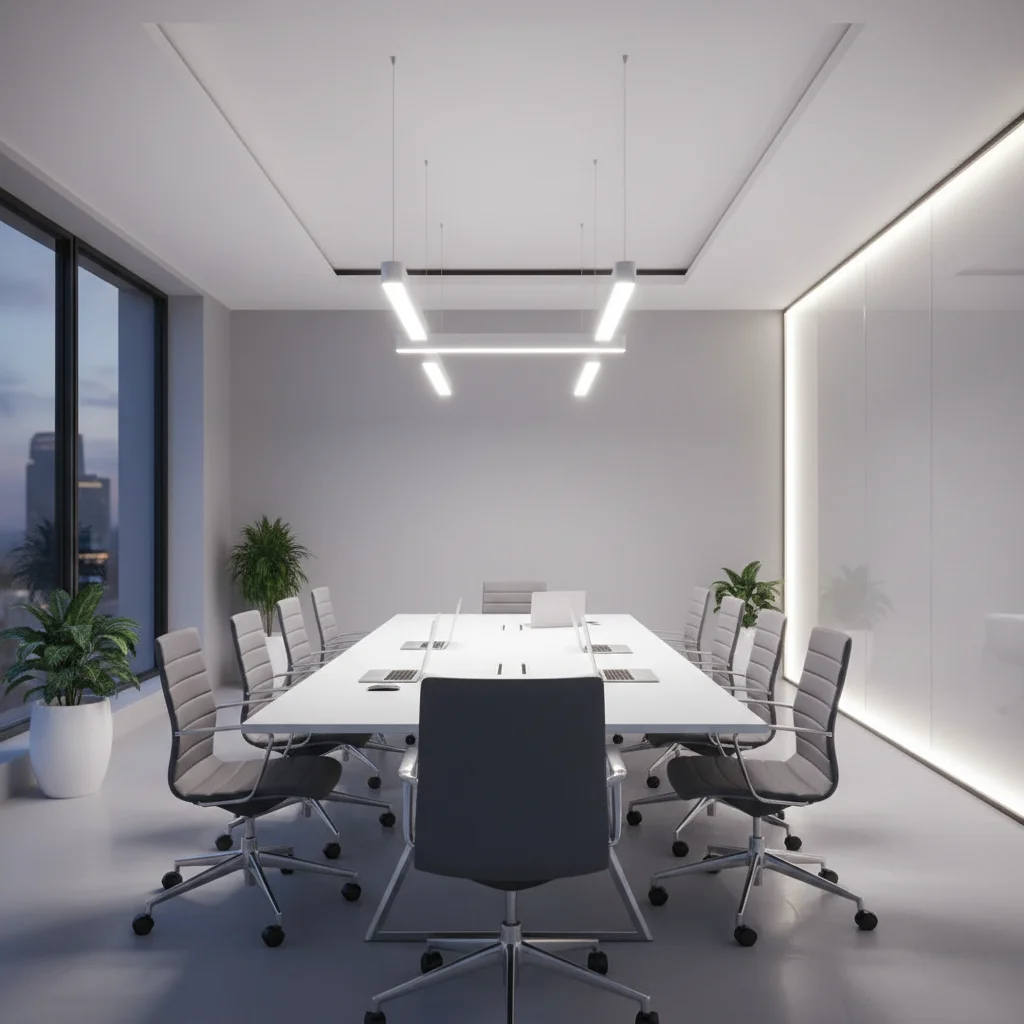
In an office environment, proper lighting is indispensable for employee productivity, comfort, and eye health. For general office areas and meeting rooms, an illumination level of 500 lux is generally recommended, while for detailed tasks such as technical drawing, 750 lux, and for corridors, 100-150 lux. These values are determined in accordance with the European standard EN 12464-1 and aim to provide ideal working conditions.
What is Lux and Why is it Important in Office Lighting?
Lux (lx) is an international unit that measures the amount of light falling on a surface. Technically, it is defined as the amount of lumen (luminous flux) falling on one square meter. In other words, it expresses how bright a surface appears. In an office environment, the correct lux level is vital for employees to comfortably perform their visual tasks, minimize eye strain, and enhance their overall well-being.
Insufficient lighting can lead to eye strain, headaches, and lack of concentration; while excessive lighting can cause glare and discomfort. Both situations lead to a decrease in productivity and an increase in error rates. Therefore, having lux values appropriate for the intended use of office areas is fundamental to creating a healthy and productive working environment.
What is the Relationship Between Lumen, Lux, and Illuminated Area?
Lumen (lm) expresses the total amount of visible light emitted by a light source. It is a measure that indicates how much light a bulb or luminaire produces. Lux, on the other hand, indicates how much of this lumen amount is spread over a specific surface, i.e., the illuminance of the surface. Simply put, it is calculated by the formula: lux = lumen / square meter.
To illustrate this relationship, let's give an example: If a luminaire emitting 2000 lumens illuminates an area of 10 square meters, the average illumination level in this area will be approximately 200 lux (2000 lumens / 10 m² = 200 lux). However, this is a simple estimation; factors such as light distribution, reflection properties, and luminaire efficiency affect the actual lux value.
Therefore, in an office project, merely looking at the lumen values of luminaires is not sufficient. Environmental factors such as the placement of luminaires, ceiling height, and the colors of walls and furniture also directly affect the final lux level. A correct lighting design aims to achieve the targeted lux values by considering all these components.
Recommended Lux Values for Office Areas (EN 12464-1 Standard)
The European standard EN 12464-1 specifies lighting requirements for indoor workplaces. According to this standard, minimum illumination levels (lux) are determined for different office areas. These values represent the basic level required for employees to perform their tasks safely, comfortably, and efficiently.
In areas where continuous visual tasks are performed, such as general office areas and meeting rooms, an illumination level of 500 lux is generally recommended. This provides sufficient visual clarity for common office activities such as reading, writing, and computer use. In areas where highly detailed and attention-demanding tasks such as technical drawing or precise assembly are performed, this value can go up to 750 lux.
On the other hand, in transition or short-term use areas such as corridors, stairwells, and archive rooms, lighting requirements are lower. For such areas, levels of 100-150 lux are generally considered sufficient. This differentiation ensures energy efficiency while also providing appropriate lighting for each area's purpose.
How Does Insufficient or Excessive Lighting Affect Office Productivity?
Insufficient lighting has a series of negative effects on office workers. It can lead to physical discomforts such as eye strain, headaches, and difficulty concentrating. This situation reduces employee motivation, increases error rates, and significantly decreases overall work productivity. In the long term, insufficient lighting can also cause eye health problems.
Excessive lighting can be just as harmful as insufficient lighting. High light levels, especially when combined with uncontrolled glare, can tire the eyes and create an uncomfortable working environment. It causes reflections on computer screens, reducing visual comfort. Furthermore, excessive lighting increases energy consumption, raising operating costs and enlarging the environmental footprint.
Ideal lighting means neither too little nor too much light. When the correct lux level is combined with uniform distribution and minimal glare, it allows employees to feel energetic, focused, and comfortable. This directly and positively reflects on work quality and overall company productivity.
Why Are Glare (UGR) and Color Rendering (CRI) as Critical as Lux?
Although the lux value indicates the illuminance on a surface, it alone does not determine the quality of lighting. Factors such as Glare (UGR - Unified Glare Rating) and Color Rendering Index (CRI) are at least as important as lux for visual comfort and perception. UGR measures the level of discomfort glare caused by a lighting system. In office environments, luminaires with a UGR value below 19 are generally preferred. High UGR values cause eye strain and loss of concentration.
CRI, on the other hand, expresses how naturally and accurately a light source renders colors. Sunlight's CRI value is considered 100, which is the situation where colors are perceived most accurately. In office environments, accurate color perception is critically important, especially in sectors such as graphic design, architecture, or textiles. Lighting products with a high CRI value (generally 80 and above) preserve the vibrancy and accuracy of colors, increasing visual clarity and reducing eye fatigue.
Therefore, when designing office lighting, it is crucial not only to achieve the targeted lux values but also to select luminaires that offer low UGR values and high CRI values. The balanced combination of these three factors is key to creating a truly comfortable and productive working environment.
How to Calculate the Correct Lux for Office Lighting Projects?
Achieving the correct lux values in office lighting is not limited to simply choosing a light bulb. This requires careful evaluation of a series of factors and detailed calculations, often performed using professional lighting design software. Elements such as room size, ceiling height, reflectivity ratios of wall and floor materials, window positions, and natural light ingress directly influence lighting design.
Professional lighting designers use this data to optimize the type, number, placement, and light distribution of luminaires. In this way, homogeneous and targeted lux levels are achieved at every point in the office, while also ensuring glare control and energy efficiency. Such a detailed analysis goes beyond the general approaches commonly found 'typically' or 'in the market', offering the most suitable solution specifically for your office.
Seeking expert consultancy for a precise and optimized lighting project is the most appropriate approach. Our lighting experts in our store can help you design high-performance and energy-efficient lighting systems tailored to your office's needs, in accordance with the EN 12464-1 standard. Contact us to increase your business's productivity and your employees' comfort.
Recommended Lighting Lux Values for Different Office Areas (According to EN 12464-1)
| Office Area | Recommended Minimum Lux Value | Notes |
|---|---|---|
| General Office Areas | 500 lux | For general office tasks such as computer work, reading, and writing. |
| Meeting Rooms | 500 lux | For activities such as discussions, presentations, and note-taking. |
| Technical Drawing / Detailed Task Areas | 750 lux | For precise and detailed visual tasks, technical drawing, assembly. |
| Corridors and Transition Areas | 100-150 lux | For orientation and general safety. |
| Reception and Waiting Areas | 200-300 lux | For first impressions and a comfortable atmosphere. |
| Kitchen / Break Areas | 200-300 lux | For social interaction and short breaks. |
Related guides: What is Linear Lighting and Where is it Used?, What is a Magnetic Track Lighting System?, LED Strip Selection Guide: How to Choose the Right LED Strip?. For turnkey implementation for your project, you can review our lighting service page.